
How to Check Criminal History in LaBelle
Begin a LaBelle search by naming the record needed. Hendry Sheriff holds its incident and arrest reports plus jail material. Hendry Clerk holds filed prosecutions and dispositions. FDLE holds reportable statewide history. The official city sources reviewed did not expose a separate LaBelle police-record portal, so the Sheriff request channel is the documented local starting point for a city event.
- Identify the agency, date, location, report number, booking number, or case number.
- Request the incident or arrest report from Hendry Sheriff or the agency that created it.
- Search the Sheriff inmate roster for current Hendry County custody.
- Use Hendry Clerk online or at the courthouse for charges, events, and the outcome.
- Use FDLE CCHInet for public Florida history or Personal Review for your own record.
This order keeps an allegation, jail entry, and judgment from being treated as the same LaBelle criminal record.
Each step answers a different question. The agency report explains why officers responded and what they alleged. The roster answers whether someone is in Hendry custody now. The docket shows what prosecutors filed and how the judge resolved it. FDLE reaches beyond LaBelle to reportable Florida events. If a warrant is the issue, do not rely on a blank web result. Call the Sheriff and issuing court, check the Clerk docket for a capias entry, and use FDLE's wanted-person system only as a lead requiring confirmation. A warrant number and issuing case are better identifiers than a name alone.
When no report number is known, begin with a narrow date range and the precise LaBelle location. Search all known name spellings in the court index, but compare case number, date, division, and charge before accepting a match. If a weekend arrest has just occurred, allow time for the prosecutor and Clerk to open a case. For an active warrant question, call the Sheriff and issuing court, review the Clerk docket, and treat FDLE wanted-person results as leads that require agency confirmation.
LaBelle Law Enforcement Through Hendry Sheriff
LaBelle differs from a city with its own police records bureau. Official municipal sources reviewed did not show a separate city police portal, while Hendry Sheriff documents the local records and jail routes used here. The Sheriff is therefore the practical first call, though FHP, FWC, FDLE, and federal agencies keep reports their own officers create.
The official City of LaBelle site supplies the municipal identity and location context a requester can use.
A precise LaBelle street, date, and event type help staff determine whether the Sheriff or another agency has the report.
Three Sheriff interfaces serve different purposes. The public-record request route seeks releasable existing documents. The inmate filter addresses current custody. The county offender map supplements the FDLE registry. Combining those tools into one broad “LaBelle background search” would hide their limits and could send a request to the wrong unit.
The city location also matters when an incident falls near a jurisdictional boundary or major road. A Florida Highway Patrol traffic stop, an FWC resource case, or an FDLE investigation does not become a Sheriff narrative merely because the person later entered the LaBelle jail. Use the agency label in the booking entry or court docket to trace the report back to its creator. If the agency is unclear, give Sheriff staff the date, exact place, and case identifiers and ask which custodian should receive the request.
LaBelle Police Department Records
No separate LaBelle police-record portal appeared in the official research. For a Sheriff-created incident, ask for an existing record by approximate date, location, record type, and any report, booking, warrant, or case identifier. State whether inspection, electronic delivery, paper copy, or certification is needed.
Hendry Sheriff is at 101 S. Bridge Street, LaBelle, FL 33935, (863) 674-5600. Ask if identification is needed for protected material. The reviewed source did not establish a stable records-desk email, fax, fee, turnaround, or required form fields. Active investigations, juvenile information, victim details, medical data, and protected video may be withheld or redacted.
A useful request describes the specific record rather than asking for everything about a person. List an incident report, arrest report, booking sheet, CAD entry, 911 audio, photograph, or body-camera segment separately. Give the approximate time and place, ask for electronic delivery when suitable, and request a cost estimate if review may require extensive staff time. Florida law permits access to nonexempt records, but it does not require the Sheriff to create a custom summary.
Requesters should also distinguish an arrest report from a local criminal-history letter. The research confirms access to Sheriff reports and FDLE statewide products, but it does not establish the scope, price, or availability of a separate Sheriff local-check certificate. Ask the office what existing record can answer the question. If the need is to review your own Florida repository history, use FDLE Personal Review. If the need is proof of a LaBelle case result, obtain the certified disposition from Hendry Clerk instead.
Two LaBelle Criminal Record Buildings
The county-seat setting makes LaBelle records look centralized, but proximity does not merge custodians. The Sheriff and jail preserve agency and custody material. The courthouse preserves prosecution dockets and court outcomes. One walk-in visit cannot be expected to produce both.
Hendry County Sheriff
101 S. Bridge Street
LaBelle, FL 33935
(863) 674-5600
Incident, arrest, booking, jail, and releasable agency records.
Hendry Clerk Criminal Department
25 E. Hickpochee Avenue
LaBelle, FL 33935
(863) 675-5217
Weekdays, 8:30 a.m.-4:45 p.m.; case files, outcomes, and certified court copies.
At the courthouse, distinguish an index result, a document image, and a certified copy. An online image is convenient for reading a LaBelle docket, while a certified copy is the Clerk's formal proof of what the court file contains. Clerk staff can locate and copy records but cannot advise what a plea, adjudication, sealing order, or open warrant means for a particular person.
The two-building distinction is especially useful when a name appears in both systems. Sheriff staff can address the incident, intake, bond, release, or historical booking material they maintain. Clerk staff can address case numbering, filed counts, hearings, judgments, sentences, and certification. Neither office can make the other office's record complete. Call ahead when a document is old, restricted, or needed in certified form, and describe the exact service sought before traveling to the LaBelle counter.
Arrests and Bookings in LaBelle
The Hendry inmate search is the official starting point for current custody. Its free interface offers a Type to Search filter, Read More, and Notify Me of Status Change. An entry reflects jail status and initial allegations, not guilt. Prosecutors may amend or decline charges.
A released person may disappear from live results. That does not mean the LaBelle arrest was deleted. Search Hendry Clerk, call the jail, and request the historical arrest report and booking sheet separately. Include the date, location, and identifiers. Use FDC Offender Search after transfer to state custody and the BOP locator for federal custody.
The arresting-agency field is the best routing clue. A traffic arrest inside or near LaBelle may have been made by Florida Highway Patrol, while wildlife enforcement may belong to FWC. A state or federal investigator keeps its own narrative even if Hendry Sheriff handled the booking. The Hendry County arrest history guide follows those agency and custody channels in more detail.
Timing can explain an apparent gap. Jail intake begins with identity, property, screening, fingerprints, a photograph, charges, and holds. A first appearance and bond decision follow, while a prosecutor separately reviews the allegations. A weekend LaBelle booking may therefore appear before a court case opens. Later release, transfer, or correction can change the roster. Save the public case or booking identifier needed for follow-up, but do not treat an initial charge as a conviction or republish a private person's booking image.
LaBelle Report Versus Hendry Court File
A Sheriff report describes the response, investigation, probable cause, and allegations. A booking record documents intake and custody. A Hendry court file begins after charges are filed and records arraignment, motions, pleas, judgment, sentence, and later supervision events. These records may share a name yet answer different questions.
| Record | Custodian | Meaning |
|---|---|---|
| Incident or arrest report | Creating agency | Narrative and alleged conduct |
| Booking | Hendry Sheriff | Intake, bond, and custody |
| Criminal case | Hendry Clerk | Filed counts and disposition |
Read the LaBelle court chronology rather than stopping at a status label such as “closed.” The docket may show the prosecutor's information, arraignment, amended or dismissed counts, plea or verdict, adjudication, sentence, probation, and later violation or capias activity. A booking allegation may never become a filed count, and a court dismissal does not automatically erase the earlier agency record.
The same distinction helps when a court image is unavailable. Docket text may remain public even when a document is confidential, counter-only, sealed, or withheld under a court order. Ask the Clerk whether an image can be inspected or copied and whether certification is available. For a report narrative, return to the creating agency. For a statewide chronology, compare the FDLE cycle. No one LaBelle interface promises all three, and a careful search records which source supplied each fact.
LaBelle Municipal Court Records
No separate LaBelle municipal criminal docket was located. Criminal prosecutions route through Hendry County Court or Circuit Court in Florida's Twentieth Judicial Circuit. County Court hears misdemeanors and criminal traffic. Circuit Court hears felonies and juvenile delinquency. Use the Hendry Clerk criminal page and records gateway.
| Court Name | Hendry County Court and Circuit Court |
|---|---|
| Case Types Heard | Misdemeanors and criminal traffic in County Court; felonies and juvenile delinquency in Circuit Court |
| Case Lookup Channel | Hendry Clerk online gateway or LaBelle courthouse counter |
| What the Docket Shows | Case number, division, status, charges, events, disposition, and available documents |
| Copies & Fees | Ask for inspection, an image, or a certified copy; current fees were not established |
Use a uniform case number whenever it is available. If searching by name, try known spelling variants and then verify the displayed filing date, court division, charges, and disposition. A missing image can mean the document is counter-only, confidential, sealed, or simply unavailable through the viewer. Ask the Clerk which explanation applies instead of assuming the entire LaBelle case is missing.
Florida's court structure also prevents a common template error. LaBelle does not need a fictional municipal criminal database to explain local cases. A misdemeanor or criminal-traffic matter is a Hendry County Court file, while a felony is a Circuit Court file. The courthouse counter serves both. City ordinance or code questions may require separate verification, but the research does not support promising that those matters appear in an independent LaBelle criminal portal.
Correcting a LaBelle Criminal History Match
A name match is not fingerprint identification. Hendry's index covers local cases, while FDLE assembles reportable events from across Florida. A person reviewing their own record may use FDLE's free Personal Review process with fingerprints taken by a law-enforcement or criminal-justice agency. A certified LaBelle court disposition can document an amended charge, dismissal, or outcome.
The FDLE Personal Review page explains the correction route.
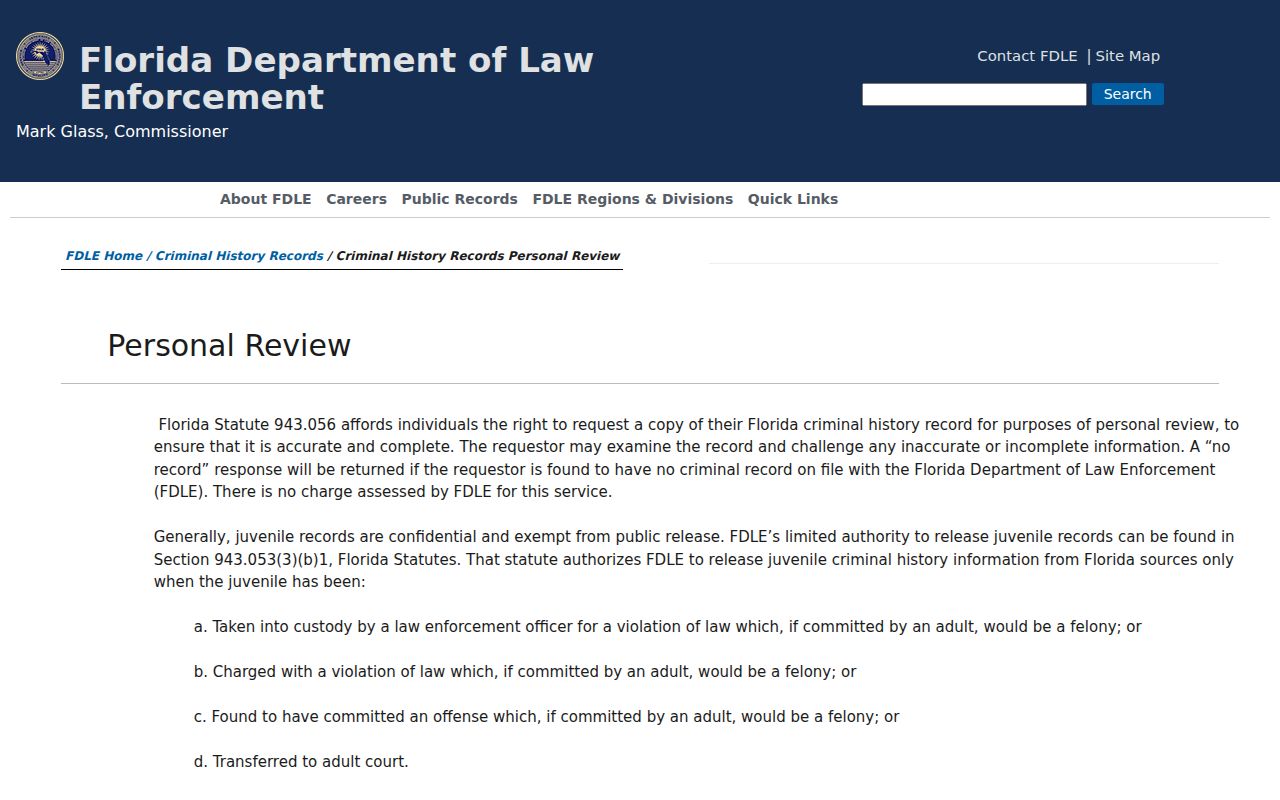
This fingerprint-supported process is stronger for an identity dispute than repeating the same public name search.
FDLE describes criminal history as a chronology of arrest, disposition, and incarceration. Reporting delays or unmatched dispositions can leave a cycle incomplete. Compare the Personal Review result with a certified Hendry disposition, then use FDLE Criminal History Record Maintenance to challenge inaccurate or incomplete Florida data. The free subject-review procedure differs from the paid public CCHInet result.
Where LaBelle Records End Up
A LaBelle event can create several files. The agency writes its report. Hendry Sheriff creates a booking if the person enters jail and transmits fingerprints. The State Attorney chooses charges. Hendry Clerk opens the County or Circuit case, and disposition reporting later updates FDLE.
Record flow: Hendry Sheriff or arresting agency › Hendry County or Circuit Court › Florida Department of Law Enforcement
Recent activity may appear first with the agency or jail. Filed counts and outcomes belong in court. FDLE CCHInet adds statewide scope but should not replace a certified court disposition. The broader Hendry County criminal history overview explains those county and state layers in depth.
CCHInet costs $24 plus a $1 card-processing fee for an instant public search, and that result is not certified. FDLE also offers staff-conducted searches with stated processing periods. Those products cover public Florida repository information, not every LaBelle incident narrative, current jail fact, confidential case document, federal matter, or out-of-state event.
A complete search can therefore require more than one stop. Start locally when the question concerns a recent LaBelle event. Move to the court docket for filed charges and disposition. Add FDLE when the scope is public Florida history, and use FDC only when state prison or community supervision is relevant. Federal cases use PACER and federal custody uses BOP. These higher layers should stay secondary on a city page because they do not replace the two named LaBelle counters.
LaBelle Fingerprints and State Record Scope
Florida uses registered Livescan submitters for authorized state-and-national checks. The receiving agency supplies the ORI that controls destination and statutory fee. FDLE does not choose it for the requester. Hendry Sheriff advertises fingerprinting, but the research did not establish a stable local price or appointment rule, so call (863) 674-5600.
The FDLE national-check guidance distinguishes Livescan from a public name search.
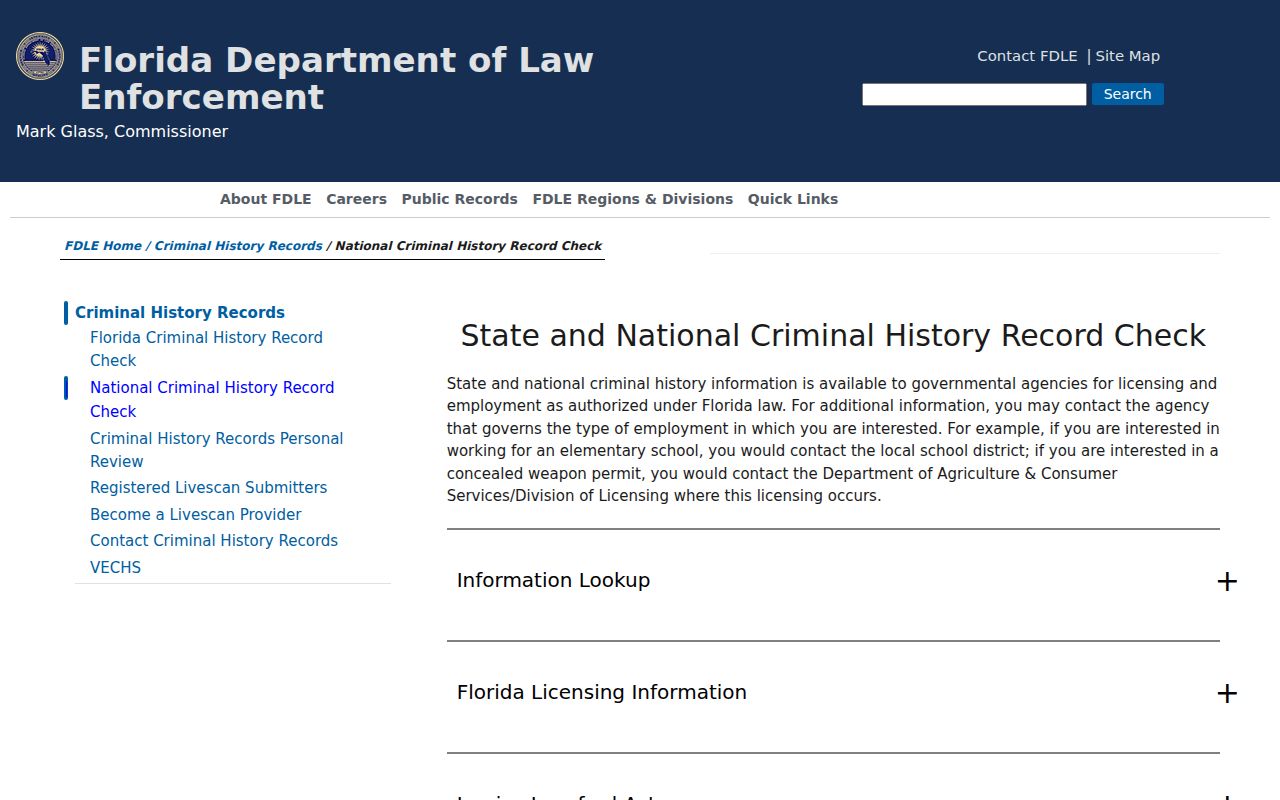
For self-review, use Personal Review rather than assuming an authorized-purpose transaction sends results to the subject.
Clearing a LaBelle Criminal Court Record
Sealing or expunction begins with an FDLE Certificate of Eligibility, then moves to the Hendry criminal department. Eligibility depends on disposition, prior adjudications, earlier relief, and exclusions. The certificate does not compel a judge to grant relief, and Hendry Clerk says it expires for filing after 12 months.
The Florida expunction statute supplies the legal framework.
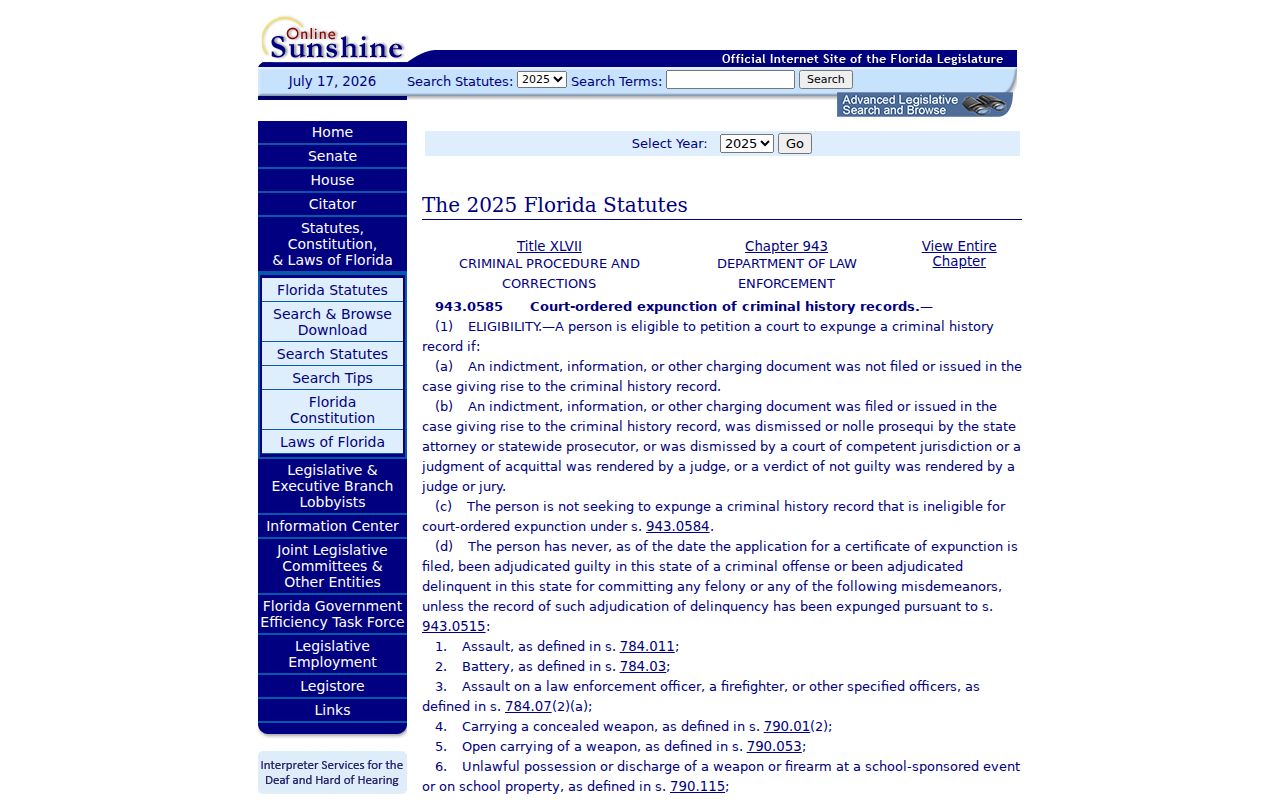
After an order, confirm implementation with the Clerk, arresting agency, Sheriff, prosecutor, and FDLE.
Sealing and expunction are not the same as a pardon or a simple online deletion. Sealing removes ordinary public access while specified agencies may retain access authorized by law. Expunction directs destruction and limited retention subject to statutory exceptions. Private copies obtained before relief are not necessarily recalled, which is why follow-up with each official custodian matters.
The petition is tied to the court that handled the case. Obtain the FDLE certificate first, then ask Hendry's criminal department for the current petition and order materials. Do not invent a fee or download link when the current research does not confirm one. Once relief is entered, compare the Clerk display and FDLE Personal Review result, and contact the arresting agency or Sheriff about its implementation. A closed LaBelle case is not automatically sealed, and an eligible certificate is not itself a court order.
LaBelle Criminal Records in a Large County
LaBelle had 4,966 residents in the 2020 Census and serves as the seat of a county spanning about 1,156 land square miles. Those facts explain its western service role, not a crime trend. The named LaBelle offices remain the first local options; Clewiston or state agencies matter only when they hold a distinct record.
The Census QuickFacts profile provides the population source.
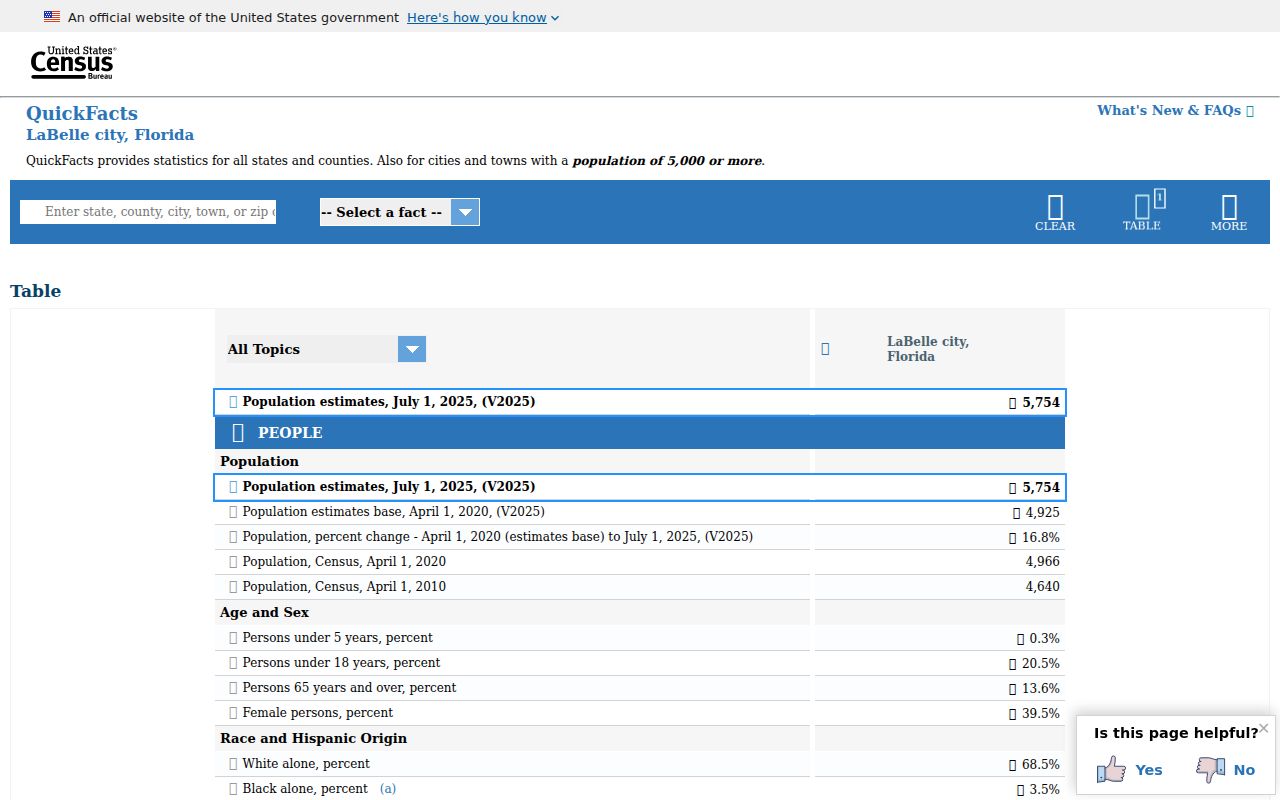
Local scale reinforces the main rule: choose the record's custodian, not simply the nearest government building.
Finding an Older LaBelle Arrest Record
The current inmate filter is built to answer a present-custody question. It is not a permanent LaBelle arrest archive. When a person has been released, transferred, or never booked into Hendry County Jail, an empty search can be expected. Begin the historical search with the approximate arrest date and the agency that made the arrest. Ask Hendry Sheriff for the arrest report and booking sheet as two distinct records when the Sheriff handled both. If another agency made the arrest, request its narrative there and ask Hendry Sheriff only for the county booking material it created.
Next, search Hendry Clerk for the resulting prosecution. A case number is the best locator, but known spelling variants, filing dates, and court division can narrow a name search. Compare the court charges with the booking allegations because a prosecutor may file different counts, amend them later, or decline prosecution. Read through disposition and sentence entries rather than using “open” or “closed” as a shortcut. If no case appears after a recent arrest, allow for filing delay and contact the criminal counter with the available report or booking number.
Older LaBelle custody may also have moved beyond the county system. FDC Offender Search covers state imprisonment and public community-supervision fields. The BOP locator covers federal custody, and PACER holds federal dockets. Those tools do not prove what happened in Hendry court and should be used only when the known record points to their jurisdiction. A person absent from FDC may still have a county disposition, just as a person absent from the live Sheriff roster may have an older booking.
A focused written request reduces false matches and processing time. Identify the type of record, a short date span, the LaBelle location, the arresting agency, and every known number. Ask for electronic delivery or inspection and for a cost estimate before extensive work. Avoid requesting every record tied to a common name when a case number or date can separate people. If the goal is to correct your own statewide entry, follow the FDLE Personal Review process and provide the certified Hendry disposition needed to connect the right outcome.
Historical searching also calls for care with restricted material. Juvenile records, sealed or expunged files, victim information, active investigative documents, and protected evidence may not be public. A docket may show that an event occurred while the image remains unavailable. Ask the custodian whether a nonexempt portion can be released and which law or court rule controls the withheld part. Do not infer that a missing LaBelle record proves there was no event, and do not infer guilt from an arrest record that lacks the later court result.
Keep a simple source log while working. Record the office, search date, identifiers used, and whether the result came from a live roster, agency response, court docket, certified copy, or FDLE product. That note makes later changes easier to explain. Custody can change quickly, an amended count can replace an arrest allegation, and a disposition can reach FDLE after the local docket. Recheck the originating LaBelle office before relying on a stale printout, especially when the question concerns an active warrant, present custody, or whether a sealing order has reached each custodian.
Public Access Rules for LaBelle Records
Florida Constitution Article I, section 24 and Chapter 119 generally permit inspection of nonexempt agency records serving LaBelle. Public does not mean every field is online. An office supplies existing responsive records and need not create a report or give legal advice. Narrow dates, locations, types, and identifiers help locate material and control extensive-use costs.
Key Statutes:
Florida Public Records Law, Chapter 119 - governs agency inspection, copies, fees, and exemptions.
Florida Statutes § 943.053 - controls state criminal-history dissemination and its public fee.
Florida Statutes § 943.056 - establishes personal review and challenge.
Judicial records also follow Florida Rule 2.420. Juvenile, sealed, victim-sensitive, active investigative, and court-restricted material may be unavailable or redacted.
A juvenile name generally will not search like an adult LaBelle case, and sealed or expunged material should not be expected in an ordinary public result. Marsy's Law supports protection of victim information. When part of a report is exempt, ask whether the remaining nonexempt portion can be released and request the legal basis for any withholding.
Access rules also shape how a LaBelle request should be written. Ask for a defined record over a useful date range, not an agency-created explanation. State whether a noncertified electronic copy is enough or a certified court copy is required. If an office expects extensive personnel or technology use, ask for an estimate before work begins. For a disputed identity, do not rely on shared names or dates of birth alone. Fingerprints and the case number provide stronger ways to separate two people and connect the correct disposition.